Alison Knowles: Retrospective 1960–2022
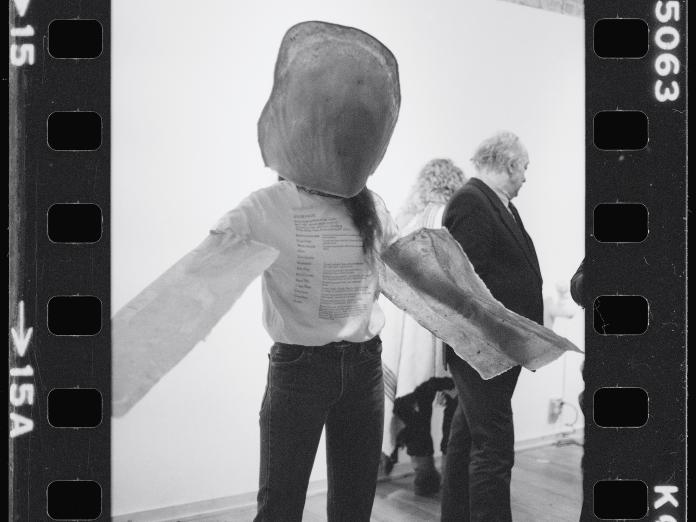
With the exhibition "Alison Knowles: Retrospective 1960–2022", Nikolaj Kunsthal presents the first comprehensive tribute to the pioneering American Fluxus artist Alison Knowles (1933–2025). Since the 1960s, Knowles has been a central figure within the international avant-garde, with a diverse artistic practice ranging from small hand-held objects and scores – the so-called event scores – to large-scale spatial installations, iconic food performances and Fluxus poetry.
Throughout her lifelong engagement with everyday materials, found objects and the textures of daily life, Knowles’s mission was to create poetic works that combined the playful experimentation of the Fluxus movement with a sensorial, social and everyday-oriented perspective. The exhibition maps six decades of artistic production – from the radical experiments with action, sound and image in the 1960s to the participatory works of the 2000s. During the exhibition, several of her most significant performances will be restaged – in the very space where the history originally began.
Fluxus at Nikolaj Church
It is no coincidence that the church hall of Nikolaj Kunsthal provides the setting for this exhibition. Under the direction of Knud Pedersen, Nikolaj Church became an international hub for the Fluxus movement in the 1960s – a place where art and everyday life met in radical actions. It was here that the landmark festival Festum Fluxorum in 1962 marked the movement’s arrival in Denmark.
Here, Alison Knowles, the only female artist in the original Fluxus group, stood side by side with pioneers such as Henning Christiansen, George Maciunas, Dick Higgins, Eric Andersen, and Arthur Köpcke. Her early commitment and central role in the dissemination of the movement in both the United States and Europe made her an inseparable part of the international avant-garde – and therefore of Nikolaj Kunsthal’s own history.
The Art of the Ordinary
For Knowles, Fluxus was a playful engagement with reality – an invitation to recognise the extraordinary within the ordinary. Through the use of instructions, sound, text and found objects, she insisted on a democratic form of art in which audience engagement and the act itself are just as important as the finished work.
She was among the first artists to work with food as an artistic medium – most famously in "Proposition #2: Make a Salad" (1962), in which a giant salad is chopped and mixed before being served to the audience, and "The Identical Lunch" (1969), in which she ate precisely the same meal every day for an entire year. In the exhibition, visitors can also encounter the monumental work "The Boat Book" (1967), which transforms the book into an inhabitable installation, as well as "The House of Dust" (1967), one of the world’s first computer-generated poems, which has manifested itself as architecture, sound and poetry. The latter will be restaged during the month of June in a special collaboration with students from Johan Borups Højskole.
A Life’s Work Across Six Decades
The exhibition is organised chronologically, guiding visitors through six decades of artistic practice. At the Lower Gallery, Knowles’s early years from the 1960s to the early 1970s unfold with a focus on serigraphs, scores, mixed media collages, and the legendary Fluxus actions at Nikolaj Church.
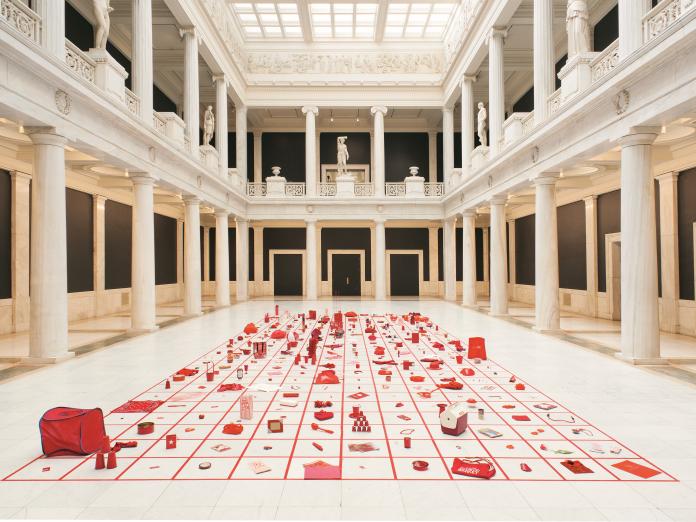
At the Tower Gallery and Upper Gallery, works from the 1970s to the present are presented, where the universe becomes even more sensorial and tactile. Here visitors can encounter everything from the onion-skin scores "Onion Skin Scrolls" to the interactive bean sandbox "The Bean Garden" and whimsical, handmade linen instruments. Together with the collective work "Celebration Red", in which visitors are invited to donate red objects from their own lives, these works highlight Knowles’s lifelong focus on sound, organic materials, and active participation.
An Open Work
Alison Knowles’s art is not only about looking but also about participation and sensory experience. Her works remind us that beauty and poetry reside in what is close at hand – in the sound of a bean, the taste of a simple lunch, the tactile sensation of paper, or the essence of the colour red. By elevating the trivial objects of everyday life into artistic material, Knowles created a democratic and open space in which the boundaries between artist, artwork, and viewer dissolve. Her legacy is an insistence that art is a living process, continually unfolding in its encounter with audiences and with the life that surrounds it.
The exhibition has previously been shown at BAMPFA (Berkeley Art Museum and Pacific Film Archive), Museum Wiesbaden and Musée d’art moderne et contemporain (MAMC+) in Saint-Étienne. After Nikolaj Kunsthal, it will travel to Grey Art Museum, New York.
"Alison Knowles: Retrospective 1960–2022" has been curated by art historian Karen Moss and organised by BAMPFA. The exhibition has been realised with support from the Terra Foundation for American Art and from Dr. Rosalyn M. Laudati and Dr. James Pick. It is also supported by National Endowment for the Arts, City of Copenhagen, the Danish Arts Foundation, Augustinus Fonden, Aage og Johanne Louis-Hansens Fond, the Knud Højgaards Fond and Beckett-Fonden.
About Alison Knowles
Alison Knowles (1933–2025) was an American visual artist born in New York who became a central figure in the Fluxus movement. She graduated from Pratt Institute in Brooklyn in 1956 and, from the 1960s onwards, worked at the intersection of performance, sound, text and visual art. Knowles is particularly known for her experiments with everyday materials and actions, where food, sound and language often became artistic media. She collaborated with artists including Marcel Duchamp and John Cage, the latter of whom she studied under at The New School for Social Research in New York in the late 1950s.
In 1961, she became part of Fluxus, an international artistic movement known for its experimental performances, happenings and intermedia works that play with chance, humour and audience participation. The movement challenged the boundaries between art and everyday life. Artists such as George Maciunas, Yoko Ono and Nam June Paik were central to its development. In a Danish context, figures including Henning Christiansen, Arthur Köpcke and Eric Andersen played particularly important roles. Read about Alison Knowles.
About curator Karen Moss
Karen Moss is an art historian, curator, educator and author based in Santa Monica, California. She has served as Professor of Critical Studies and Director of the Curatorial MA Programme at the USC Roski School of Art and Design and has held senior positions at institutions including the Orange County Museum of Art and the Walker Art Center. She holds a BA from UC Santa Cruz and an MA and PhD from the University of Southern California. Most recently, she authored "Alison Knowles: A Retrospective (1960–2022)", a monographic publication examining Knowles’s artistic practice and her central role in the Fluxus movement. Read more about Karen Moss.